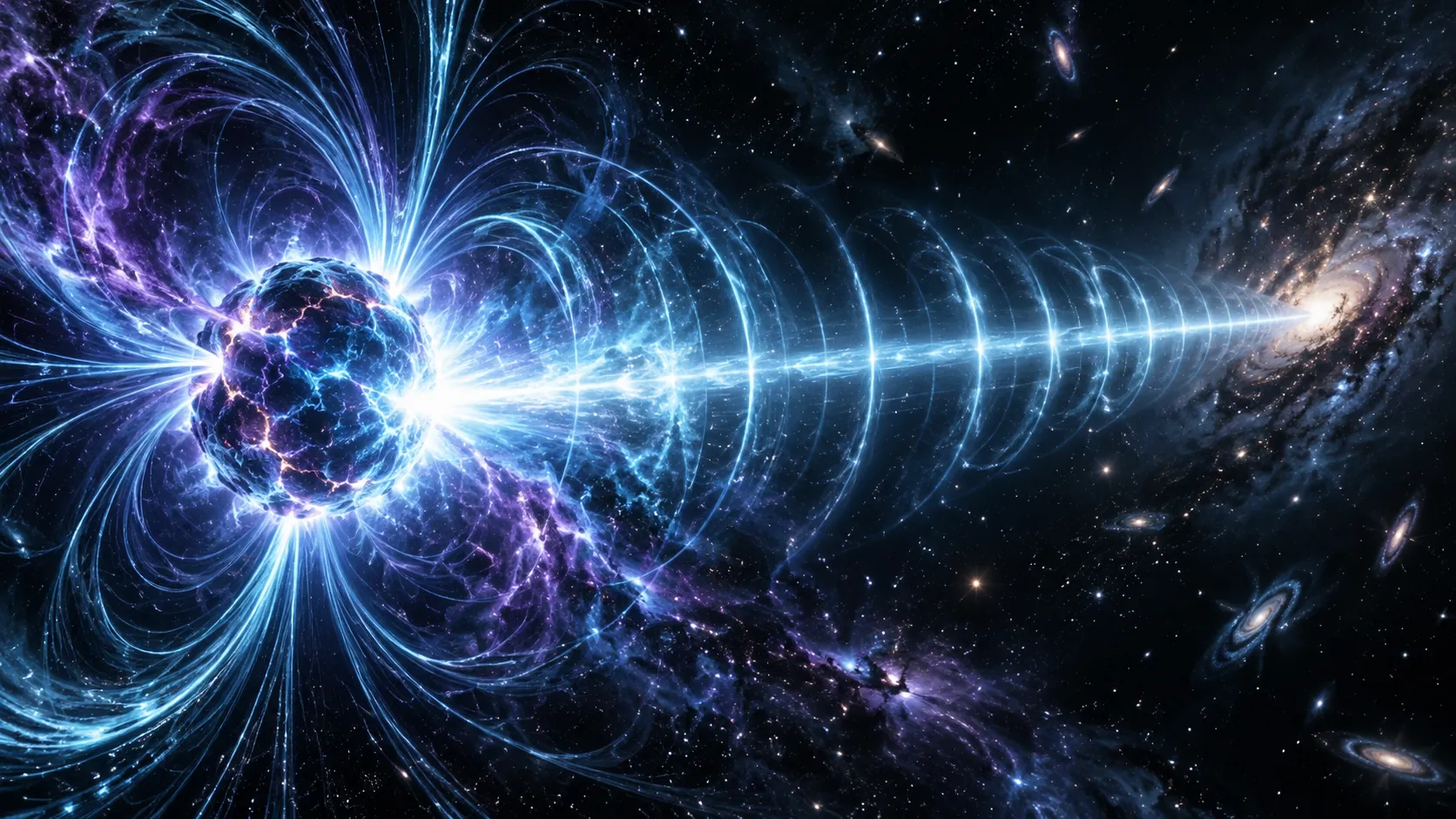
Fast radio bursts last milliseconds yet can be immensely energetic. A burst linked to a magnetar provides a crucial clue, but not a complete explanation.
A flash shorter than a blink
Fast radio bursts, often shortened to FRBs, are brief flashes of radio emission detected by sensitive telescopes. Some last only a few thousandths of a second. Their brevity is deceptive: signals from distant galaxies imply that their sources can release extraordinary amounts of radio energy on tiny timescales.
A radio telescope records these events as changes in signal intensity across frequency and time. Radio waves at different frequencies travel through ionized gas at slightly different speeds. The resulting delay, called dispersion, helps researchers estimate how much material lies along the path. It is useful evidence, not a simple ruler that produces an exact distance on its own.
Why magnetars entered the story
A magnetar is a neutron star with an exceptionally strong magnetic field. Neutron stars are compact remnants formed from certain massive stars after their cores collapse. Their extreme magnetic and gravitational environments offer mechanisms capable of creating violent, rapid changes in emission.
In April 2020, radio observatories detected a remarkable burst from the direction of the Galactic magnetar SGR 1935+2154, alongside high-energy activity. NASA describes it as the first FRB-like signal observed from within the Milky Way. It was a major advance because a known class of object was associated with an event resembling the enigmatic radio bursts seen in other galaxies.
An important clue is not a universal answer
The 2020 event demonstrated that magnetars can produce extremely bright radio bursts. It did not demonstrate that every fast radio burst has the same origin. Astronomers study both repeating and apparently non-repeating events, and their measured properties and environments can differ.
A repeating source is particularly valuable because scientists can observe it again, compare its activity over time and investigate where it sits in its host galaxy. A source that has only flashed once may simply have been missed on other occasions. The distinction between “has not repeated” and “cannot repeat” matters.
How astronomers pinpoint a burst
Discovering a burst is only the beginning. Researchers want an accurate sky position, a possible host galaxy and information about the gas and magnetic fields through which the signal traveled. Wide-field radio surveys can spot candidate flashes, while arrays of telescopes can help locate their sources more precisely.
The travel path adds complications. Dense clouds of electrons alter timing, and intervening magnetic fields can rotate the signal’s polarization. Those effects make the detective work harder, but they also turn bursts into potential probes of matter between galaxies. A brief flash can illuminate a much larger landscape.
What remains uncertain
The details of how an unstable magnetar produces a millisecond radio burst are subjects of active research. Models may involve magnetic reconnection, sudden disturbances near the star or shocks farther away. Different observed bursts might favor different interpretations.
Researchers test such models against measurable features: duration, brightness, polarization, repeating behavior, associations with X-ray activity and local environment. Good explanations must account for the data rather than only provide a dramatic story.
Why the mystery matters beyond the source
Fast radio bursts are worth understanding not merely because they sound strange. Their dispersion and polarization carry signatures of material along the route to Earth. With enough well-localized bursts, astronomers can use these signals to investigate otherwise difficult-to-see ionized matter.
The magnetic clue has therefore widened the field instead of closing it. We have direct evidence that at least some magnetars produce FRB-like emission, and an expanding set of observations that may explain how bursts vary across the universe.