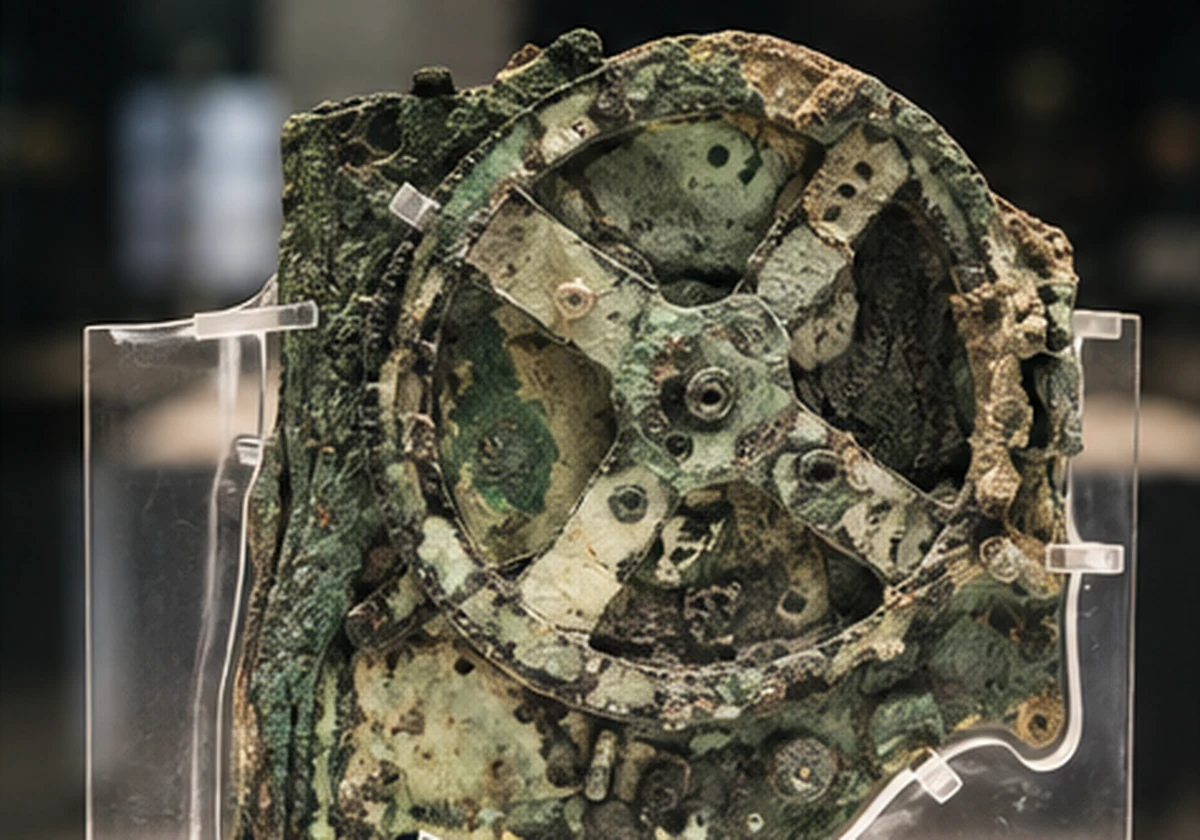
Two thousand years ago, someone built a machine that could turn astronomy into motion. Its surviving pieces are corroded, incomplete and small enough to fit in a museum case. Yet the Antikythera mechanism is one of the most astonishing clues we have about the technical ambitions of the ancient Mediterranean world.
It is often called the first analog computer. That label is useful, provided we understand what it means: not a programmable electronic machine, but a sophisticated set of bronze gears designed to represent astronomical cycles and produce calculated indications.
A shipwreck, a discovery, and a very unusual object
In 1901, divers recovering objects from a shipwreck near the Greek island of Antikythera brought up fragments of what initially looked like unpromising lumps of bronze. Their significance emerged gradually, as scholars recognized traces of precisely cut gear teeth and inscriptions.
Today, researchers work with 82 surviving fragments, including around 30 identifiable bronze gearwheels. A 2021 research paper notes that only about a third of the original mechanism survives. That missing material is central to the story: every reconstruction must negotiate the difference between surviving evidence and informed inference.
What did the machine actually do?
The mechanism encoded cycles associated with the Sun and Moon, calendars and eclipse prediction. A person operating it could turn an input and read positions on dials, using a mechanical model rather than calculating the relevant astronomical periods from scratch each time.
Its rear displays are particularly illuminating. The Metonic cycle relates 19 solar years to 235 lunar months, a relationship useful for bringing lunar and solar calendars into alignment. The Saros cycle spans 223 lunar months, approximately 18 years and 11 days, and is associated with the recurrence of eclipse patterns. These are not mystical numbers: they reflect long-term observation translated into mathematical cycles.
The National Archaeological Museum’s educational materials explain these cycles and how their representations fit the instrument. The mechanism is remarkable precisely because it combines astronomy, mathematics, craft and an interface readable by a human operator.
How do we read a machine that barely survives?
The surviving bronze is fragile and badly corroded. Researchers therefore rely heavily on imaging and computational reconstruction. In 2005, microfocus X-ray computed tomography provided a much clearer view of buried gears and thousands of characters within the fragments. Evidence once inaccessible to the naked eye became available for interpretation.
Much of the rear gearing and its functions have been reconstructed with considerable confidence. The front of the mechanism is less completely understood. A 2021 study in Scientific Reports presented a detailed model of its proposed planetary display, using surviving inscriptions and mechanical constraints. It is an important research model, not proof that the entire original front arrangement is definitively settled.
Why did this technology seem to disappear?
It is tempting to imagine a forgotten civilization, secret inventors or a vanished industrial revolution. The historical explanation is more demanding and more interesting: sophisticated ancient knowledge could exist within networks of expert craftspeople without leaving behind a continuous series of surviving machines.
Bronze was reusable, fragile instruments were easy to lose or dismantle, and the archaeological record is incomplete. The Antikythera mechanism therefore tells us that at least one workshop could build an exceptionally intricate astronomical calculator; it does not show that such devices were common or manufactured at scale.
We also do not know with certainty who designed this particular instrument or where it was built. Connections to major Greek astronomical traditions are plausible, but naming a single celebrated inventor would go beyond the evidence.
Could it really have worked as accurately as we imagine?
Not necessarily. Different researchers have questioned how manufacturing imperfections, wear and alignment would have affected practical operation. A 2025 discussion reported by Smithsonian highlights this issue: a mechanically ingenious design is not automatically a precision instrument under real-world conditions.
This distinction matters. An impressive reconstruction can demonstrate a feasible layout, while experimental analysis can ask a different question: how well could the original device have run? Both questions are useful, and both remain open to refinement.
The real mystery is not supernatural
The most extraordinary part of the Antikythera mechanism is not that it defies history. It is that it expands history. It reveals a community of ancient thinkers and makers capable of modeling complex celestial relationships in metal, and it challenges modern assumptions about a simple, linear march of technological progress.
Whenever someone claims the mechanism proves impossible technology or advanced lost civilizations, the responsible response is to return to the fragments, inscriptions, scans and testable reconstructions. The genuine story is already surprising enough.
Further reading and sources
- National Archaeological Museum: What is the mechanism and what does it consist of?
- Freeth et al., 2021, A Model of the Cosmos in the ancient Greek Antikythera Mechanism, Scientific Reports
- Smithsonian Magazine: How well did the mechanism actually work?
On reconstruction: Models of the missing parts are hypotheses constrained by surviving evidence. They should not be confused with directly observed features of the artifact.