Deep-sea exploration reveals ecosystems powered by chemistry, difficult-to-map landscapes and living species still unfamiliar to science.
The biggest habitat is hard to visit
The ocean covers roughly seventy percent of Earth’s surface. Its sheer size already makes exploration demanding, but the deep sea adds darkness, cold water, enormous pressure and difficult communication. A research vessel can sail over an area in hours while learning surprisingly little about what happens several kilometers below.
It is important to distinguish three activities that are often lumped together. Bathymetric mapping estimates seafloor shape; direct visual exploration records what a camera or person can actually see; biological sampling studies organisms and habitats. A region can be mapped without having been visually inspected in detail.
A discovery that changed the rules of life
In 1977, researchers exploring the seafloor encountered thriving communities around hydrothermal vents. The discovery fundamentally changed how scientists thought about the sources of energy that sustain ecosystems. These deep environments have no sunlight for ordinary photosynthesis, yet organisms can flourish around chemical-rich fluids.
Microbes at some vents use chemical reactions to make organic matter, a process known as chemosynthesis. Other creatures rely on these microbes directly or through symbiotic partnerships. This does not mean the whole deep sea runs on chemicals; many deep environments still depend on food sinking from surface waters. It shows that sunlight is not the only foundation for a food web.
Why vents are more than exotic scenery
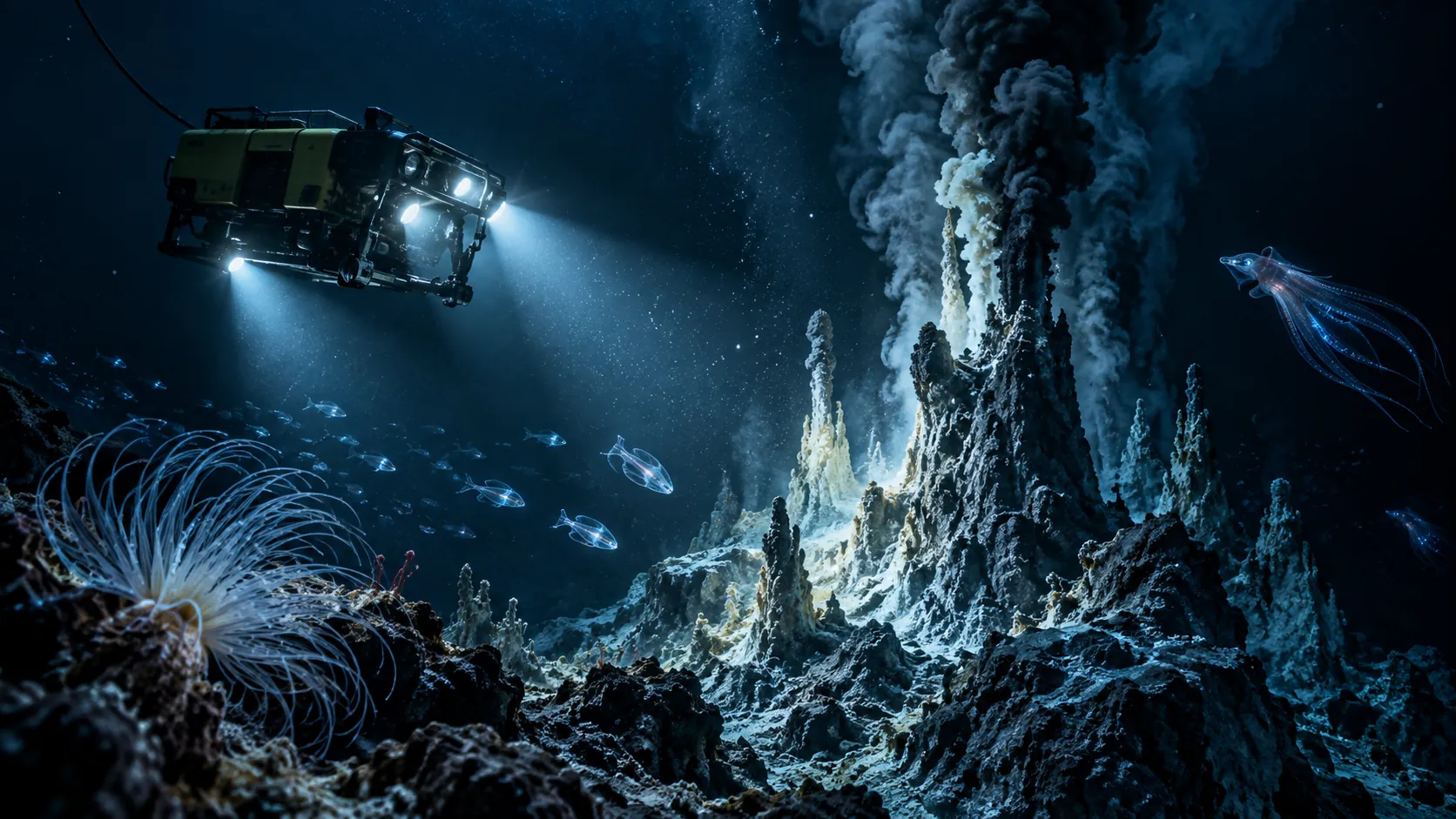
Hydrothermal vents form when seawater seeps through fractured crust, heats near geological activity and returns to the ocean carrying dissolved substances. The mineral-rich fluid can build distinctive chimney structures. Conditions vary from place to place, so research teams study chemistry, heat, geology and the species present together.
Vent communities can be vulnerable to changes in the fluid flow that supports them. Some sites may be active for years; others change as geological conditions evolve. Understanding these ecosystems requires repeated visits rather than a single impressive video from a remotely operated vehicle.
The machines that make discoveries possible
Sonar can outline the seabed from a ship or underwater vehicle, while remotely operated vehicles bring cameras, lights and sampling tools to otherwise inaccessible depths. Autonomous underwater vehicles can cover planned survey routes. Each platform offers a trade-off among detail, operating cost, range and the level of human control.
A photograph showing a glowing organism or unusual rock formation is compelling, but context matters. Scientists want location, depth, environmental measurements and carefully preserved samples when appropriate. Such records help distinguish a new species from a familiar organism seen under unusual lighting.
Why new species are not the only surprise
Deep-ocean discovery can be geological, chemical or ecological. Researchers may identify a previously unmapped canyon, an unexpected microbial community, a cold seep where fluids escape from sediments, or a relationship between animals and microorganisms that challenges an old assumption.
The ocean also contains evidence of Earth’s history: sediments, ancient climate signals, landslides and volcanic structures. Exploration is therefore not a treasure hunt for strange creatures alone. It is a way to understand the planet’s functioning and the processes that shape coastlines and climate.
Curiosity without exaggerated claims
Claims that “we know almost nothing about the ocean” can be misleading. Scientists understand a great deal about marine physics, chemistry and major ecosystems. What remains sparse is fine-grained coverage of an immense and changing environment, especially direct observation at depth.
The best ocean stories respect both sides: decades of rigorous research and enormous room for discovery. The next surprise may be a species, a geological structure or a process that forces researchers to revise an existing model.