Voyager 1 and 2 crossed the heliopause, but neither has left the Sun’s enormous gravitational neighborhood. Here is what interstellar space actually means.
A boundary that cannot be seen
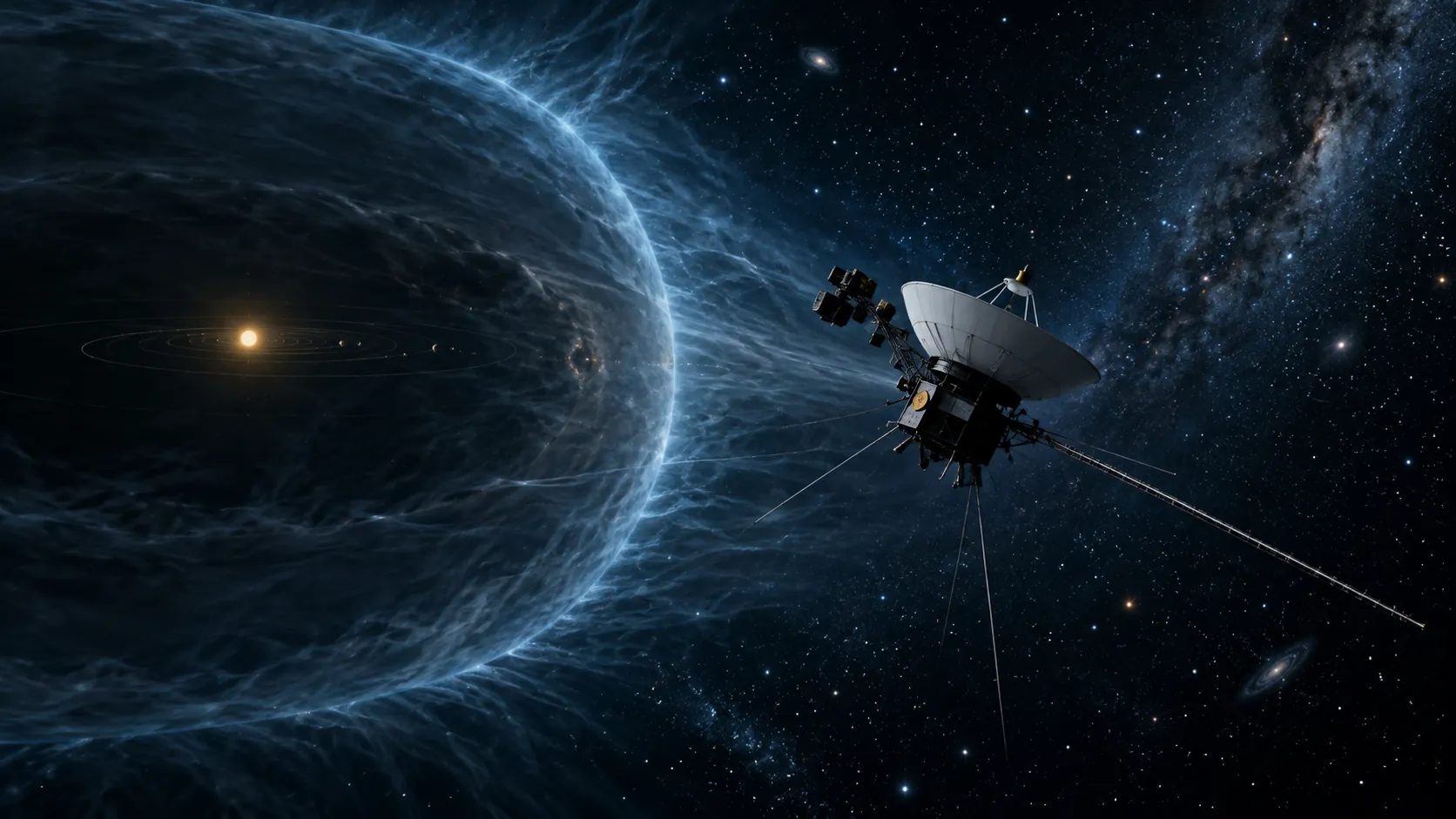
There is no painted line in space announcing the end of the Sun’s territory. The boundary the Voyagers crossed is the heliopause: the region where the outward flow of solar wind meets the surrounding interstellar environment. The Sun continuously releases charged particles that create a vast protective bubble called the heliosphere. Its shape changes under the influence of solar activity and the conditions outside it.
When NASA says Voyager 1 entered interstellar space in 2012, it means the spacecraft moved beyond this solar-wind-dominated bubble. Voyager 2 followed in 2018, taking a different path through the heliopause. Neither probe crossed a physical wall. Scientists recognized the transitions through changes in particle populations and plasma conditions measured by their instruments.
Leaving the heliosphere is not leaving the solar system
The phrase “outside the solar system” is tempting, but it hides a distinction. If the solar system is defined by the Sun’s magnetic and plasma influence, crossing the heliopause is an important exit. If it is defined by the enormous gravitational domain of the Sun, the Voyagers are nowhere near its outer reaches. Distant reservoirs of comets may extend far beyond the probes.
This is why NASA carefully distinguishes interstellar space from every possible definition of the solar system’s edge. The spacecraft have entered the material between stars while still remaining gravitationally connected to the Sun. Both ideas can be true at once.
What the instruments can tell us
The Voyagers were launched in 1977 to explore the outer planets, not to operate indefinitely in interstellar space. Their extended mission is therefore a remarkable second life. Instruments that examine charged particles, cosmic rays, magnetic fields and plasma waves can reveal conditions no spacecraft had previously sampled directly beyond the heliopause.
The machines do not send ordinary photographs of the interstellar medium. Instead, researchers interpret streams of measurements and compare them with physical models. Patterns in plasma waves and magnetic fields can expose how the heliosphere interacts with material moving through our part of the galaxy. The result is less cinematic than a starship crossing a border, and scientifically more interesting.
Why the data gets harder to collect
Communicating with a distant spacecraft requires powerful antennas, patient scheduling and carefully managed electricity. Radio signals travel at the speed of light, yet the vast distance means commands and replies take many hours. The spacecraft’s power output also declines over time, forcing engineers to prioritize instruments and switch off equipment as needed.
The achievement is not that two machines will operate forever. It is that scientific teams continue to extract meaningful observations from hardware built for a very different era. A single packet of data can still help researchers test how our Sun’s bubble behaves.
A message from Earth that was never a broadcast
Each Voyager also carries a Golden Record, a gold-plated copper phonograph disc containing selected sounds, music, greetings and images from Earth. The record is not an active transmitter. It is a physical time capsule attached to a spacecraft that is unlikely ever to be encountered by another civilization.
Its purpose is cultural as much as technical. The scientific measurements describe the space beyond the heliosphere; the record says something about the people who sent the probes. Together they make the Voyager mission both an experiment and a durable statement of curiosity.
What comes next
The most useful questions are practical: which instruments remain operational, what changes do they detect, and how do those changes compare with models of the heliopause? Distance records make memorable headlines, but the physical environment remains the story. As engineers conserve the remaining power, the science will increasingly depend on disciplined choices about which observations matter most.
The Voyagers do not prove that humanity is close to traveling between stars. They show something subtler: a spacecraft designed to study Jupiter and Saturn can become a rare observatory for the material between stars, decades after the original planetary encounters ended.